Showing posts with label June. Show all posts

Monday, June 29, 2026

USGA report

Back on June 1st we welcomed our regional USGA Agronomist to Bretton Woods for a course consulting visit. From the USGA Green Section website: these visits “provide an objective, impartial, science-based evaluation of all factors influencing turfgrass health, playability, and sustainability.”

During our visit, we touched on several topics related to the Bermuda grass, including shade and tree removal, aeration practices, and Spring Dead Spot control. We also spent time discussing the health and performance of the putting greens. As well as the interface between the cool season turf collar and the warm season turf approach and difficulties of managing that line. Overall, it was a valuable investment that we will continue in years to come.

To conclude the service, the visit is summarized into a written report for the hose facility. Below is the link to our report.

https://drive.google.com/file/d/1vXeOFSLhtV-tHz_8uvTJ0ciauPN-r3yl/view?usp=sharing


Thank you


Etiquette Reminder of the Month

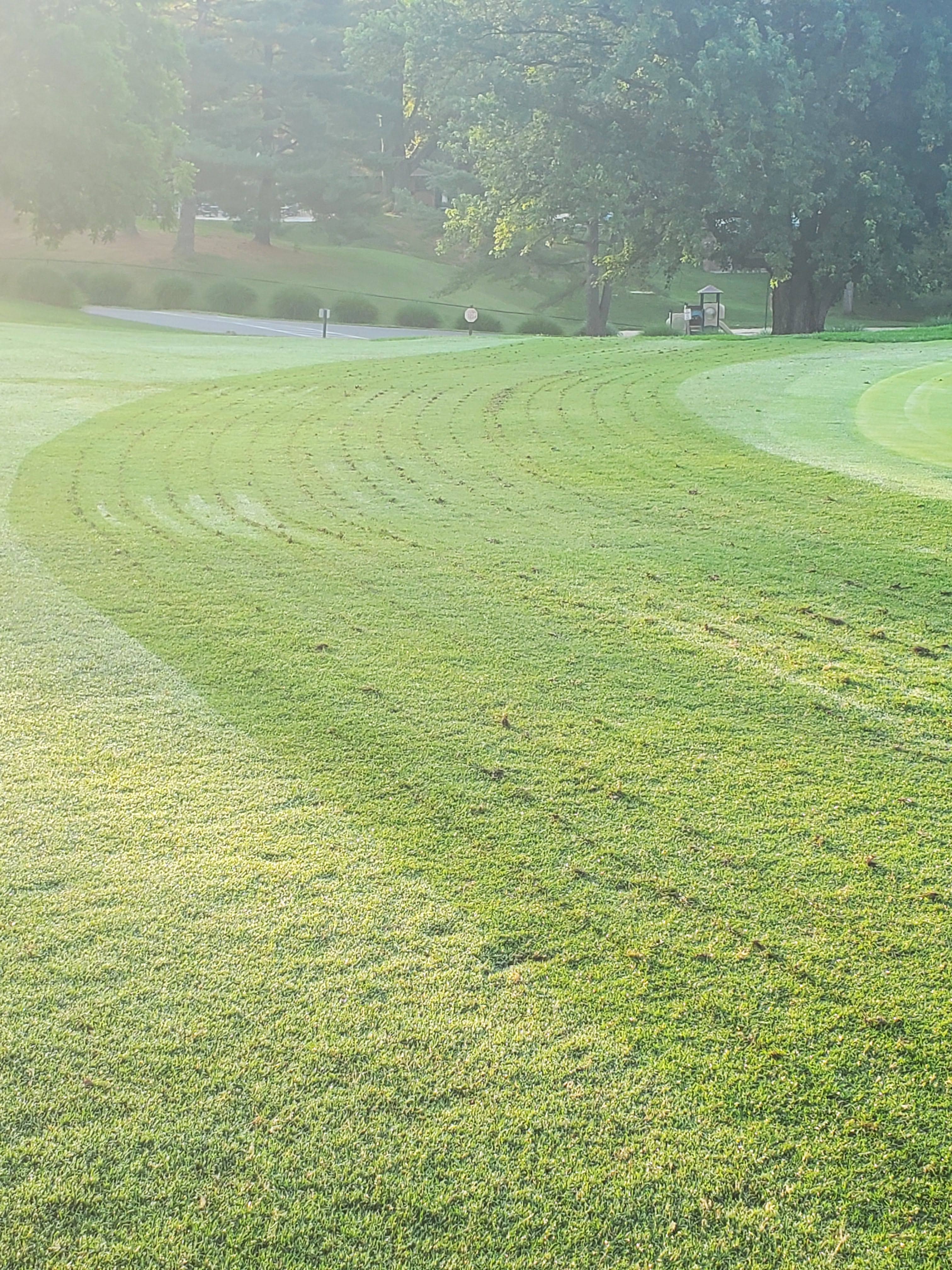
Golf carts are capable of a very tight turning radius, but please don’t turn that sharply in the grass because it can tear the turf.


Also, as part of a Golf Committee initiative to improve course etiquette, we have included links to videos teaching proper on course etiquette. Please take a moment to watch:

Ball Marks - How to properly repair

Golf Cart tips


See you on the course!

Joe

jvillegas@bwrc.org

Monday, June 22, 2026

Drought

We are in the midst of a drought, on the East coast, Maryland, and Montgomery County. We are fortunate to have Bermuda grass during times like these, but even Bermuda grass still requires water, and it is showing the indications of the drought.


From January 2026 through May 2026, we are about 5” behind our normal rainfall. Last fall, we had to recharge our irrigation pond due to a shortage. Luckily, with significant snowfall over this past winter, the pond was able to reach full capacity to start the season. But the shortfall of rain again this spring is creating water deficiencies that are becoming increasingly obvious across the course.

We work hard to manage the moisture on all turf areas on the course. Greens and the rough immediately around the greens take priority because they are cool season turf and of highest value. Using water and labor for these areas is paramount or the turf would suffer quickly, and recovery would be slow if at all. Beyond this turf though, we have a luxury with Bermuda grass being a very drought-tolerant species and having lower water requirements than other grasses. Nevertheless, when it gets this dry, even the Bermuda grass can show signs of stress.


Cool nights and relatively low daytime temperatures have allowed us to stretch our water reserves further than expected. There have been very few rainstorms rolling through, but some of them have come at just the right time to help us extend our water. These quick shots of rain help the Bermuda grass stay hydrated too and it can go longer between water events than other turf. But now the Bermuda grass is turning brown in many locations, showing the tell-tale signs of drought stress. Brown Bermuda grass can be seen on edges of fairways and tees where sprinklers don’t reach well or at all. Even areas that get good irrigation coverage are showing signs of stress just because they aren’t getting enough water. All these areas will rebound once there is ample water in the soil again (rain is forecast today) but it will take time.

We will continue to balance judiciously using our water supply while also maintaining the health of the turfgrass. Bermuda grass comes with a full set of problems at certain times of the year, but when it is this dry, we are glad to have the Bermuda grass.


Etiquette Reminder of the Month

Golf carts are capable of a very tight turning radius, but please don’t turn that sharply in the grass because it can tear the turf.

Also, as part of a Golf Committee initiative to improve course etiquette, we have included links to videos teaching proper on course etiquette. Please take a moment to watch:

Ball Marks - How to properly repair

Golf Cart tips


See you on the course!

Joe

jvillegas@bwrc.org

Monday, June 15, 2026

Quick needle tine aeration

Cultural practices have been happening at a blistering pace recently. Last Monday we discussed the work we have been doing with the Verti-quake which has been ongoing over the last couple of weeks. That discussion prevented a discussion on the quick aeration we fit in on the greens just this past Monday also. We used very small, solid tines to open some pore space one last time before the intense summer stretch of late June through July.

The tines we use are nicknamed “needle” or “pencil” tines because of their small diameter, though they are wider than a needle and skinnier than a pencil! Nevertheless, their diameter is 1/8” and the goal is to open up some channels for air to enter the soil and water to move through the profile, which ultimately encourages roots to grow deeper.

This is typical timing for us to do this practice. We are right at the last point that the turf on the greens will be able to truly grow new and deeper roots. From here through the rest of the summer, roots will slowly shrink because of high soil temperatures. After early June, we would only do this again if there was some sort of failure in an area of a green that had become sealed at the surface and was no longer accepting water into the profile. Otherwise, there is not much benefit from the aeration during the summer because roots cannot go deeper anyway. And an even bigger concern is that because the roots are short and weak, the aeration can actually lift the turfgrass, separating the soil down deep from the plant and roots. This heaving can be very detrimental during the heat of the season, so we try to avoid it at all costs.

We were able to accomplish our aeration without any collateral damage, getting most greens aerated on Monday, and finishing the last few greens on Tuesday morning. A quick roll behind the aerator and the holes virtually disappear immediately, and with mowing and rolling through the week, the holes are gone before the weekend. It is a minimally disruptive procedure but can be of great benefit.

Timing is everything for us, especially when balancing accomplishing our goals not only around golfers, but also Mother Nature. Squeezing in our last aeration prior to August worked great. We have set the greens up as best as we can to handle the upcoming summer.


Etiquette Reminder of the Month


Golf carts are capable of a very tight turning radius, but please don’t turn that sharply in the grass because it can tear the turf.


Also, as part of a Golf Committee initiative to improve course etiquette, we have included links to videos teaching proper on course etiquette. Please take a moment to watch:

Ball Marks - How to properly repair

Golf Cart tips


See you on the course!

Joe

jvillegas@bwrc.org

Monday, June 8, 2026

Verti-quake


One of our newest machines has been busy lately. The Verti-quake is a large, linear aerator, designed to cut deep channels into the ground. We have finished our top priority areas, and we will start an entire fairway soon.

We have briefly discussed the Verti-quake before here and here. Instead of a typical aeration that pokes holes in a grid pattern, the Verti-quake uses large knives that slice down into the soil for sub-surface disruption. Two of the main differences, and thus benefits, of the slicing versus the regular aeration are the depth we can reach and the total area impacted.

Surface area impacted is a function of tine diameter and spacing. If we use very large diameter tines and make holes really close to one another, we are impacting a greater area. And if we use small diameter tines and spread them far apart, the disturbance shrinks. For the Bermuda grass, we use ¾” diameter tines, spaced about 2” apart. This is a relatively average, typical setup and it roughly impacts about 7% of the surface. Where the Verti-quake stands out is because the knives cut a continuous path, unlike the aerator that only pokes a hole every 2 inches. We don’t have a specific percentage of surface disruption because the equation is not as straightforward, but the idea is that rather than only poking holes every so often, the Verti-quake is breaking up the soil along its entire path.

But the more important way the Verti-quake improves upon a typical aeration is the depth to which we can reach. Our regular aeration only reaches about 2-3” deep. The Verti-quake can work down to at least 10” and we are slicing about 4-4.5” deep currently. There are regular aeration machines that can match that depth, but they again are only poking holes at a certain interval. And if the aerator is working in poor soil, which we definitely have, then the regular aerator may not be able to penetrate the hardpan, and you will not accomplish the depths needed. Because the Verti-quake uses knives that cut through the soil instead of pounding down into it, it is capable of working through some extremely tight soil.

We had some top priority areas that we wanted to work through with the Verti-quake first: both soccer fields, 2-4 passes across all of the approaches (which includes several of the main areas of Bermuda sod work), and then historical weak areas on #1, #4, #5, #7, #11, #15, #17, and #18 fairways. All of that has been done over the last month. Next, we will tackle #8 fairway in its entirety, over the next couple of weeks. Our goal is to finish #8 fairway, and possibly one or two more this summer. But over the coming seasons, we will strive to finish all the Bermuda grass on the course at the current working depth, and then work back through everything again, pushing the machine deeper and deeper each time.

The Verti-quake will not replace our regular aeration program because it accomplishes different goals. The machine operates slowly, but working to shift the texture and structure of our soil is also a slow process. The Verti-quake is another tool for us to continue to improve growing conditions across the course.


Etiquette Reminder of the Month

Golf carts are capable of a very tight turning radius, but please don’t turn that sharply in the grass because it can tear the turf.


Also, as part of a Golf Committee initiative to improve course etiquette, we have included links to videos teaching proper on course etiquette. Please take a moment to watch:

Ball Marks - How to properly repair

Golf Cart tips


See you on the course!

Joe

jvillegas@bwrc.org

Monday, June 1, 2026

More new mulch areas


Golf is played on turf and golf courses spend most of their resources maintaining the turf to the highest quality possible. But part of the experience of being out on a golf course is the aesthetic value not just of the turf but of the entire surroundings. Continuing the work we have been doing recently to improve our aesthetics, we are gradually adding some new mulch areas.

We don’t have unlimited labor and funds to manage every aspect of the property to the highest standards. Sometimes we must find ways to make things easier to manage, without compromising on quality. Similarly, we are also looking for ways to make the peripheral aspects of the course look better- the areas outside the main corridors of play. The stone work we discussed recently is a big part of this process. But we are also adding or extending new mulch areas to improve visuals also.

Many of the areas that we will be changing already have mulch in some capacity, either nearby that we are connecting to, or in the same place that we are just increasing. The mulch provides a nice contrast to the turfgrass, and this contrast is pleasing to the eye. We are also strategically adding mulch to locations that benefit our operation as well. Mulch beds are less labor intensive than grass. We only mulch once a season and managing the weeds in the mulch is very quick and easy. Comparatively, mowing rough is done at least twice per week, and takes labor and fuel. Not to mention, most of the areas that we are altering have poor grass coverage, lots of tree roots and are therefore very tough on our machines, which increases repairs. By reducing marginal areas that we must mow, we are gaining visual appeal and saving wear and tear on our machines. We have added other new mulch areas over the last couple of years. In particular, we added several to #6. This next phase of additions is a similar process but will focus a bit more around tee areas since we are working on stone nearby at the same time.

The new mulch areas provide a nice contrast to the turf. But they are also a benefit to our operation, saving us time mowing and machine repairs. Improving the aesthetics of our course and benefiting the Grounds department at the same time is a win-win.


Etiquette Reminder of the Month

Golf carts are capable of a very tight turning radius, but please don’t turn that sharply in the grass because it can tear the turf.


Also, as part of a Golf Committee initiative to improve course etiquette, we have included links to videos teaching proper on course etiquette. Please take a moment to watch:

Ball Marks - How to properly repair

Golf Cart tips


See you on the course!

Joe

jvillegas@bwrc.org

Monday, June 30, 2025

Shockwave

Soil compaction and drainage are two of the most important factors for growing good, healthy turfgrass. Dating all the way back to construction, we have dealt with some severe compaction issues from the earth moving equipment that performed the renovations. Especially, in some approach areas, the compaction has led to struggling turf over several years. Last week, we tested a different type of aerator to help alleviate some of the tight soils.


The machine we tried is called a Shockwave and it is a linear aerator. Instead of poking holes down into the soil vertically like a traditional aerator, the Shockwave has 12” knives that slice down into the soil and then carve a channel linearly as the machine moves forward. Working depth can be set from 4-10”. The blades are offset on the shaft so that across the machine there are always blades in the ground, and multiple blades per position so that a blade is always down in each channel creating a continuous slice. The Shockwave is very good at breaking up hard soil, and it can also help with drainage because water will follow the new channels.

It is hard to see, but this is a photo of
the knives that slice down into the soil


Since we were only testing the machine, we prioritized our most troublesome areas to work through first. We made multiple passes across every approach, with some approaches getting more attention than others. We ran the machine in several different directions, trying to break up as much compaction as possible, and we also made some angled passes from higher points to lower points to help move water more efficiently. Although the machine must be operated slowly- the company recommends .5-1 mph- it was very easy to use and left a clean, playable surface behind.

After completing the approaches, our next priority was some drainage swales on #15 fairway, a large portion of #17 fairway, and a large portion of #18 fairway. These were all areas that were heavily excavated and compacted during construction also and that give us trouble throughout the year. Finally, we did a section from about 100 yards and in to the green on #1, two small sections on #4 fairway, all along the right side of #5 fairway, everything from 200 yards and in to the green on #7 fairway, and a few very small areas on #11, 12 and 13 fairways. We finished with the machine over on the soccer field, which interestingly enough, had a few areas of soil that even the Shockwave couldn’t penetrate!

All this work was done at a depth of about 4.5-5”. It will take some time to see the full benefits of the aeration, but we did break through some hard soil, which can only help the health of the turf. As the turf continues to grow through this season, it should be able to root better and slightly deeper because of the lines we cut. This better rooting will lead to a stronger plant now and for the winter, and the stronger the plant is for winter, the better it breaks dormancy in the spring. Moving forward, if we were to purchase one of these machines, we would work on cutting deeper in some of the trouble areas, as well as slicing more acreage in total.

In the short term, there are some stolons of Bermuda grass that were cut by the knives and wilted and died, though fewer than we expected. The healthy Bermuda grass will heal in over these lines in a short time and all the scarring will disappear. There should be some immediate impacts on water movement through the sliced areas as water will find these channels and flow easier.

Even though we were only testing the machine, we were able to work through all our top priorities before our time was up. This is not a cure for all that can hurt the Bermuda grass, but if we can slowly work on reducing the factors working against the turf, the turf health will continue to improve.


Etiquette Reminder of the Month

When you splash bunker sand onto the green after your shot, please brush away any large piles or clumps that may have ended up on the green.

Also, as part of a Golf Committee initiative to improve course etiquette, we have included links to videos teaching proper on course etiquette. Please take a moment to watch:

Ball Marks - How to properly repair

Golf Cart tips


See you on the course!

Joe

jvillegas@bwrc.org

Monday, June 23, 2025

Another drainage update

The weather dictates nearly every aspect of our operation: what we can and cannot accomplish, and what problems we must deal with. Due to the rain in the last couple of weeks, dealing with water issues has been our focus.

Work at #13 green


#13 green


Early on last week we dealt with two more drains that were not emptying in the best locations, just like we wrote about in the previous blog. This time, work was done at #2 green and #13 green. #2 green was very simple- the drain ended about 15 feet short of where we wanted it, so the trench was extended, and new pipe was added. #13 was slightly more complicated because the last junction box for the drain line had no exit. Water simply filled the box and overflowed out into the surrounding area. Sometimes this is ok- letting the water surface and run away is what we do when we terminate at cart path edges. However, in the case at #13 green, the overflowing water was not getting away fast enough and was turning the whole area into a wet, muddy mess. Again, we trenched in a new pipe, and this was connected into the box to provide an outlet for collecting water. #2 and #13 were relatively easy fixes and probably should have been done sooner than they were, but we finished them, nevertheless.


#13 green


Replacing the sod at #13 green


The backup of water to the left of #16 was a different story. In all the previous examples, the troublesome pipes were installed many years ago, and things changed over time, so adjustments needed to be made. The water near #16, however, was sitting over the top of drain inlets, that we helped install relatively recently, and are fully aware of where the pipes start and end. Seeing water sitting for so long directly over the top of drains was concerning. Unfortunately, with so much rain, it was difficult to decipher what was draining slowly because of sheer volume and what was moving slowly because of a problem.

The backed up water at #16


Another blocked drain at #16

Finally, once the rain stopped late last week, we were sure that some other problem existed besides too much water. Probing up into the pipe, we discovered a blockage about 25 feet up inside that was restricting flow. We excavated at that position and discovered an enormous root ball that had penetrated the pipe, exploded in size, and choked off nearly 95% of the flow through the 6” pipe. Once the root mass was removed, water rushed down the pipe, and the stagnant water above the drain inlets was gone in a matter of minutes.


The root mass that was inside a 6" pipe on #16
sitting next to a hat for size reference. 
We didn't weight it, but I would guess it weighed
at least 7 or 8 pounds!

We haven’t mowed much grass recently, which we will make up for this coming week, but we were not short of other issues to work on. We solved some issues that the excess water presented. No matter what the weather is doing, one way or another, it keeps us on our toes.


Etiquette Reminder of the Month

When you splash bunker sand onto the green after your shot, please brush away any large piles or clumps that may have ended up on the green.

Also, as part of a Golf Committee initiative to improve course etiquette, we have included links to videos teaching proper on course etiquette. Please take a moment to watch:

Ball Marks - How to properly repair

Golf Cart tips


See you on the course!

Joe

jvillegas@bwrc.org

Monday, June 16, 2025

Drain extensions

Sometimes a shift in the weather is all it takes to give a new perspective on the course. In this case, May was a very wet month, and the excessive water highlighted where two drains were not working as intended. This past week we made some changes to handle water in these places in the future.

One of the most important, but also the most difficult aspect of installing drainage is locating where to daylight the pipe. Extremely long runs of pipe, surface topography, or other factors can make locating an exit point hard. Getting this wrong can lead to correcting a wet spot in one place only for the water exiting your drain to cause a new wet spot because you didn’t get the exit point located correctly, which only leads to more work. This was the case with the two drains we worked on last week, one on #9 and the other on #12.

Both drains have been operating correctly- water has been removed from the surface and flowed in the pipe as intended. Unfortunately, the exit point has become a secondary wet spot and causes us some issues with mowing. In both cases, most of the time there are no issues with the location of the drains. The water weeps out at the end and soaks into the surrounding soil. However, when the surrounding soil is saturated from rain and the water keeps seeping out of the drain also, then the water can’t percolate down, and it becomes a sloppy mess. We can’t mow the section that is too wet, or if we accidentally do, or if a cart drives through, we get ruts and destroyed turf.

So, the best solution that we have in most cases is to extend the drainpipe to a better termination point. Sometimes that might be to another drain, maybe to a point much further away and less in play, or in some cases, right to the cart path where the water can wash onto the path. For the drain on #9, we chose this last option: extending right up to the cart path. The drain still bleeds out onto the surface, but now it is onto a hard surface that can be driven on by carts and machines.


It turns out we were so busy with many different tasks, 
that we did not take any pictures during the project! Here is
a quick shot of the completed work on #9.


The drain on #12 was slightly different. We didn’t have a cart path nearby enough to get to and there was no additional drain into which we could empty. Instead, we extended this drain far enough so that it no longer impacts our mowing pattern and should be far enough away that most if not all carts will no longer drive through the exit point.

This is not the first time we have extended drains in this fashion. Just last year we extended a drain near #5 green and in the past we moved a drain at #13 green. The process is relatively simple, and we can easily finish in a day. Most of these drains are not very deep, so once we determine a new ending point, we hand dig a new trench to there, expose the old pipe, connect the new pipe, and backfill. In most cases we aren’t moving the drain further than about 20 feet, sometimes much less, so progress is made quickly.

Controlling and removing water is one of the most important aspects of turf management. Wet ground is not good for playing golf or managing grass. Sometimes getting the water just a little bit farther away can make all the difference.


Etiquette Reminder of the Month

When you splash bunker sand onto the green after your shot, please brush away any large piles or clumps that may have ended up on the green.

Also, as part of a Golf Committee initiative to improve course etiquette, we have included links to videos teaching proper on course etiquette. Please take a moment to watch:

Ball Marks - How to properly repair

Golf Cart tips


See you on the course!

Joe

jvillegas@bwrc.org

Monday, June 9, 2025

Slow progress on storm cleanup

As summer approaches, we are at our busiest time of year. Every species of grass is growing at or near its full potential and must be cut regularly. All our regular, secondary tasks must be completed as well. This is why certain jobs, like cleaning up from the most recent storms, can take us longer to accomplish. We expect to finish the last of the cleanup and repair work this week.

The most recent storm was just over two weeks ago now, and we still haven’t finished the cleaning yet. A full tree remains down on #18, logs are still left on the driving range, and a few stump holes haven’t been repaired fully. There a couple reason behind why some of this is not accomplished yet. First, and most important, in certain circumstances, we don’t have the proper tools to manage larger tree cleanup like what has occurred in the recent storms. Large chainsaws, chippers, log trucks, etc. are not part of our fleet. We could cobble together the necessary machines if we had to, but it would take time and money. Contracting with a tree removal company is most efficient, even if it means that the debris lays longer than we would like.

Secondly, the time it would take for our staff to accomplish these tasks would be too great and would be at the expense of other jobs. Nearly all our labor would be consumed with just tree removal work and most other things on the course would not be done. Whereas the tree company labor is dedicated to the cleanup process. Mowing, changing cups, raking bunkers, among other things would be skipped. This would lead to a very poor experience for several days. At this time of year, using most of our staff on one single job would leave too much else unfinished.

Even jobs that are manageable for the Grounds staff can take longer for us to get to, and finish, because of the same time constraints. Often, these cleanup tasks are after all the typical course preparation for the day is complete. The average time for morning setup and mowing jobs is 4 hours. Even then, not the entire staff is ready or available to help after that, so things can take longer. Last week, we were able to get several old stump holes sodded and we will finish up the rest of those this week.

When you see a tree or logs left on the ground for extra time after a storm, it is not because we don’t know or don’t care. It might not make sense for us to do the work with our tools, or because our time is spent on other work. We appreciate your patience as we continue to get things back to normal.


Etiquette Reminder of the Month

When you splash bunker sand onto the green after your shot, please brush away any large piles or clumps that may have ended up on the green.

Also, as part of a Golf Committee initiative to improve course etiquette, we have included links to videos teaching proper on course etiquette. Please take a moment to watch:

Ball Marks - How to properly repair

Golf Cart tips


See you on the course!

Joe

jvillegas@bwrc.org

Monday, June 2, 2025

Rough growth

It has been a while since we have discussed issues with the grounds being too wet. We were in a drought of some degree most of the last 3 years, even despite the more normal amounts of snowfall this past winter. However, May, and leading right into June, provided above normal precipitation. Keeping up on maintenance becomes an issue when the ground is wet.

May will end up being just about double the normal precipitation for the month, with the majority falling in the last two and half weeks. When the ground gets saturated, the first thing we fall behind on is mowing. We scrape by mowing the essentials with push mowers, but putting large, heavy machines out on the course causes more harm than good. But the grass doesn’t stop growing and wait for us to catch up, which leads to massive amounts of grass clippings.

Once we hit a stretch of weather dry enough to mow again, we try and catch up as much as possible. Greens, tees, fairways, and approaches are not as difficult to get a handle on again. We manage the growth of the turf on those surfaces and that helps to keep the clippings at a manageable level. Also, on greens, tees, and approaches we can collect clippings in baskets, so they aren’t left clumping in play. But our biggest hurdle comes with catching back up on rough height grass.

Green and tee surrounds, along with the general rough around the property is only mowed by large machines and we can’t collect the clippings. The result is grass clipping debris everywhere. We work to balance our mowing frequency to decrease clipping volume but not create too much wear and tear on the turf. We also use blowers to disperse the clippings once they have had a chance to dry. If we can get 2-3 regularly scheduled cuts on the grass, we can catch up and get things back in shape. Squeezing in between storms is the challenge because it takes a day or two after a storm for the ground to dry and lately there has only been a day or two before the next storm.

Cutting as much grass as we have been lately negatively impacts playability with clippings as well as increasing the hours on our machines. Please be patient with us as we work to get the rough back under control as quickly as possible


Etiquette Reminder of the Month

When you splash bunker sand onto the green after your shot, please brush away any large piles or clumps that may have ended up on the green.

Also, as part of a Golf Committee initiative to improve course etiquette, we have included links to videos teaching proper on course etiquette. Please take a moment to watch:

Ball Marks - How to properly repair

Golf Cart tips


See you on the course!

Joe

jvillegas@bwrc.org

Monday, June 24, 2024

Gas leak in approaches


Unfortunately, we experienced another gas leak on the course last week. Luckily, it was mostly a dribble, with only a few larger patches.  

We have posted before about the inevitable occurrence of leaks when working with our machines. Hydraulic fluid, gas, and diesel are required for our operation and accidents happen, both human error and machine part failure. We work hard to mitigate the risk: teaching our staff about the damage these fluids can cause, training them to replace fuel caps, and refill only on paved surfaces. Nevertheless, when something like this happens it is very depressing.

Given most of the damage is small drops and small lines, we will monitor, but likely let the grass heal itself. Depending on the severity of the damage when leads occur, sometimes we may lay new sod to partially or entirely replace the damage. At other times we may let the healing occur naturally. We could sod these spots out as well, but the work to get such small pieces of sod to fit in nicely and play well is difficult. Also, with the stretch of very warm and very dry weather we are in, keeping the small pieces of new sod alive would be very difficult and require lots of man hours.

When you are out over the next few weeks you will see the damage. Just know that we are aware, and we do work hard to prevent these accidents from happening.


Etiquette Reminder of the Month


Also, as part of a Golf Committee initiative to improve course etiquette, we have included links to videos teaching proper on course etiquette. Please take a moment to watch:

Ball Marks - How to properly repair

Golf Cart tips


See you on the course!

Joe

jvillegas@bwrc.org

Monday, June 17, 2024

Transition zone

We grow grass in a unique area of the country called the transition zone. We also grow two distinct types of grass that like two distinct weather conditions. As we move into summer, the differences in grass types becomes apparent.

The transition zone stretches primarily from Maryland and Virgina westward through West Virginia, Kentucky, and Tennessee. It is the area that “transitions” from a warmer in the south to a cooler climate in the north, and turf varieties change from primarily warm season grasses to primarily cool season grasses. The unique, and difficult aspect of the transition zone is that neither warm nor cool season grass thrive. The winters are very cold and can be damaging to warm season turf, and the summers are very hot which can be damaging to cool season turf. So, no matter the weather, some turf is unhappy.

For Bretton Woods, this dichotomy plays out daily: our greens and rough are all cool season turf, and our fairways and tees are Bermuda grass, which is a warm season grass. During the spring, greens are beautiful, healthy and thriving and take very little effort. Temperatures are cool and the weather is perfect for the cool season turf. Instead, a lot of our focus is on encouraging growth of the Bermuda grass and promoting recovery from winter damage. Air and soil temperatures are rising, but still too low for the Bermuda grass to truly be growing vigorously.

Then we enter summer, like we are right now, and the whole management process flips on its head. Mother Nature takes care of growing the Bermuda grass and we work to control its growth so that it doesn’t grow too fast. And most of our focus shifts to the cool season turf, mainly the greens, which are predominantly annual bluegrass, which is one of the least heat tolerant turf species. Moisture and disease management are critical for the greens. Turf loss can occur in the span of one afternoon if the greens are too wet or too dry or an application of preventive fungicides is missed.

The upcoming stretch of days are forecast to be very warm- the warmest of the year so far, and a longer stretch of heat than we had at any time all last year. So, for the next few months, our main goal will be to protect the cool season turf. Then once again, when fall hits, we will “transition” back to working on the Bermuda grass and protecting it for the winter


Etiquette Reminder of the Month

Please remember to remove any bunker sand that may be stuck to your spikes before walking on the greens.

Also, as part of a Golf Committee initiative to improve course etiquette, we have included links to videos teaching proper on course etiquette. Please take a moment to watch:

Ball Marks - How to properly repair

Golf Cart tips


See you on the course!

Joe

jvillegas@bwrc.org

Monday, June 10, 2024

Upper soccer field closure

This past week we had extra work to complete on the soccer field. Unfortunately, some of the work that we did earlier in the spring did not last. It was unplanned work but necessary, nonetheless.

In March we do renovation work on the upper soccer field. We lay new sod, aerate, seed, and fertilize. March is a good time to lay new cool-season sod because there is generally plenty of rain and cool temperatures. Both conditions were present this spring and the sod we put down started off strong, as did the entire field, all the way through April, and into May.

However, as we progressed through May, more rain continued to fall, and the field could not dry out. Cloudy, damp weather would not allow any moisture to evaporate, and the upper field also drains very poorly naturally. This led to water sitting in low areas far too long. Even when we were able to open the field, the wet conditions persisted. The sod from March could not handle the water, the traffic from soccer players, or being mowed regularly. The sod that started strong, quickly deteriorated and the condition of the field worsened.

Unfortunately, we made the decision to close the field and repair the bad areas. Luckily, we have two soccer fields, so all use could be shifted to the lower field. In addition, the soccer fields are not the busiest area of our facility, so dropping to one field for a few weeks was not impossible.

Having to unexpectedly close any turf area that we manage because it is performing poorly is a difficult decision to make, but having the best conditions possible is the goal. Whether it is the golf course or in this case, the soccer field, sometimes the turf can suffer, and we must make the choices that can most quickly get the surface back to where everyone would like it to be.


Etiquette Reminder of the Month

Please remember to remove any bunker sand that may be stuck to your spikes before walking on the greens.


Also, as part of a Golf Committee initiative to improve course etiquette, we have included links to videos teaching proper on course etiquette. Please take a moment to watch:

Ball Marks - How to properly repair

Golf Cart tips


See you on the course!

Joe

jvillegas@bwrc.org

Monday, June 3, 2024

Ventrac

Believe it or not, there are still some manufacturing and shipping delays left over from COVID. One of those delays in particular affects new golf course maintenance equipment, so getting new machines can still take 12-18 months from date of order. So we must be creative when the need for a new machine arises.

Mowing at the pool and around the mini golf area is a necessary evil. Both are very rough ground, with lots of roots, ruts, and other obstacles, and especially at mini golf, sometimes rocks. This abuse can really wear a mower and its components out quickly. We don’t have a particularly large fleet of equipment, so when a mower finishes one location on the property, it usually heads to a different place to continue mowing.

Although we do still share equipment across our site, the pool and mini golf were two places that we wanted a dedicated mower. Issues had arisen from using our “golf course” mowers at the pool and mini golf and then the mower having a problem and not being available to go back on the course. And we wanted to keep the quality of cut on the golf course as high as possible and sharing with the pool and mini golf was impacting that quality. Our initial plan was to order another of the same mowers that we previously used- a Toro 3500-D Sidewinder- and make it the dedicated mower for the pool and mini golf. However, that mower was subject to the aforementioned 12-18 month lead time and no used models were available. As we started looking at other options, we settled on a versatile tractor style mower.

The Ventrac shown here with
the bush hog brush cutting attachment

Our new Ventrac is an 8 wheeled tractor that can operate several different attachments. In our case, we have the typical front deck mower, but we are also able to purchase a tough cut bush hog-type mower, as well as a trenching attachment- all for less than the Toro mower we were originally planning on buying. And the Ventrac was ready and delivered within 30 days of our order.

So far, the machine has done all that we have asked for and been a useful addition to our inventory. Sometimes it isn’t what you want, but what you can get and work with. That was definitely the case for us this year, but we made some adjustments and things are working great.


Etiquette Reminder of the Month

Please remember to remove any bunker sand that may be stuck to your spikes before walking on the greens.


Also, as part of a Golf Committee initiative to improve course etiquette, we have included links to videos teaching proper on course etiquette. Please take a moment to watch:

Ball Marks - How to properly repair

Golf Cart tips


See you on the course!

Joe

jvillegas@bwrc.org

Monday, June 26, 2023

Needle tine season

It is the time of year that we solid tine the greens for summer health and we have been doing it for several years. The last two weeks we have done 1/3 of the course each Monday, and today we finish up the last group.

Continually breaking the surface of the greens is a great way to ensure healthy turf. Oxygen can more easily enter the system; the soil cannot seal off and so water is allowed to penetrate. Our last aeration was back in mid-February, so it is time to poke holes again.

At this time of the year, we are not looking to remove material from the greens with hollow tines. We also do not want to be very disruptive to the surface. So, we opt for ¼” diameter, solid “needle” tines. Solid tines do not pull any material back out when they exit the green; they only make a hole. And the needle tines are so small that, at the surface, the hole is barely noticeable, especially once we run over the green once with a roller. But the channel stays open below the surface and the turf continues to benefit.

This week we will complete the last 6 greens, which will finish one cycle across all the putting greens. We will take the week of July 3rd off due to the holiday, then start one more round across the greens again the final 3 weeks of July, working on Mondays. At that point we are only two weeks from our scheduled summer aeration and another opportunity to vent the greens.

Not all “aerations” are created equal; we don’t have to cause enormous disruption, remove material, and close the course. Using needle-tines during the season allows us to minimize the footprint but maximize the benefits.


Etiquette Reminder of the Month

Golf carts must always remain on cart paths once past the green and white posts, through the next tee complex. This is not weather dependent!

Also, as part of a Golf Committee initiative to improve course etiquette, we have included links to videos teaching proper on course etiquette. Please take a moment to watch:

Ball Marks - How to properly repair

Golf Cart tips


See you on the course!

Joe

jvillegas@bwrc.org

Monday, June 19, 2023

Full greens stepcut

Sometimes when the greens get very firm, approach shots can land hard, bounce, and then run all the way through to the back of the green. Starting this year, those shots can now stop in the new intermediate cut of rough around the greens.

The new intermediate cut is two
push mower widths. It is the first two passes in the
darker green rough grass.

Prior to this year, the ball rolling into the rough around the greens could sometimes end up in some very thick rough. The result did not always match the quality of the original shot. Though missing the green is still missing the green, a middle ground between green’s height turf and thick rough was warranted.

From this angle it is a little bit easier to see 
the difference in height of cut between the new step cut
and the rough just beyond.

Last year we tested this new addition to our program. The turf handled the adjustment well, and the added job was not too difficult to integrate into our routine. So, this year we took the next step and introduced the new intermediate cut around all 20 greens. We have been mowing this new portion since early spring and so far, the results have been positive. The turf continues to manage being cut shorter and the Grounds staff has done an excellent job of making the new task a part of our weekly to-do list. And golfer feedback has been very positive as well.


The new greens step cut will continue to be part of our mowing schedule. If the turf continues to handle the stress, the intermediate cut will be here to stay.


Etiquette Reminder of the Month

Golf carts must always remain on cart paths once past the green and white posts, through the next tee complex. This is not weather dependent!

Also, as part of a Golf Committee initiative to improve course etiquette, we have included links to videos teaching proper on course etiquette. Please take a moment to watch:

Ball Marks - How to properly repair

Golf Cart tips


See you on the course!

Joe

jvillegas@bwrc.org

Monday, June 12, 2023

It's very dry

How dry has it been? Depending on the source (there are several to choose from) we are somewhere between 7 and 9 inches of rain behind normal for the year. We are certainly seeing the effects of the drought on the course.

Seemingly since January, we have had warm days (relative to the time of year), wind, and low humidity. Couple those factors with the lack of precipitation, and the first half of the year has been very dry. This isn’t the first time our area has been dry, you can read these posts- dry weather, drought- but notice the dates on those past posts- one is from September and the other October. This is the driest, the earliest in the year in quite a long time. This lack of water plays a role in many ways across the course.

First, any grass that is not irrigated has turned dormant brown. Almost all soil moisture has been lost, with no replenishment, and the grass has activated its defense mechanism to survive: turn brown and stop growing. Luckily, with some sustained moisture, most, if not all this turf will bounce back, but it is striking to see, nonetheless.

The lack of moisture has also affected the healing and recovery of the Bermuda grass. Though not as limiting as the cool nights we have had, the lack of moisture has also kept the Bermuda grass from thriving. The Bermuda grass is irrigated, so it has not gone dormant anywhere, but the irrigation is only a supplement to rain, not a replacement. The Bermuda grass will start its summer push once the rain returns, but for now it has definitely been restrained.

Without rain, and using many gallons of irrigation water, the pond level on 17 also begins to drop. Most often we get enough timely rainstorms to recharge the level. But not this season; we have had a few small amounts of rain here and there, but nothing enough to add significant amounts to the pond. So, for the first time in 7 years, we need to rent a pump to add water from the Potomac River to refill our pond. Hopefully, once we fill the pond back up, we will make it the rest of the year without having to pump again.

Lastly, relying for so long on the irrigation system alone is very inefficient. Even a brand-new system will start to form wet and dry areas over a long period of use. However, our system is very old and is showing its age. The irrigation system was put in long before our 2014-2018 renovation, so it does not match the current course. Likewise, when the irrigation system was put in there were different turfgrass species on the tees and fairways. All of this contributes to dry areas even near sprinklers, or areas that are too wet. We have contracted with a consultant to start the process of replacing our irrigation system, but we are several years away from reaping the benefits.

In many ways, being too dry is more manageable than being too wet- we can add more water, but it is very hard (or impossible) to remove excess water. Nevertheless, we would still like some rain.


Etiquette Reminder of the Month

Golf carts must always remain on cart paths once past the green and white posts, through the next tee complex. This is not weather dependent!

Also, as part of a Golf Committee initiative to improve course etiquette, we have included links to videos teaching proper on course etiquette. Please take a moment to watch:

Golf Cart tips


See you on the course!

Joe

jvillegas@bwrc.org

Monday, June 5, 2023

Petanque court renovation

One of the very unique aspects of Bretton Woods is the variety of activities offered. Golf, tennis, soccer, are the big three, but our ropes course, miniature golf, and pétanque are not to be overlooked. Often, the pétanque court was overlooked, but we just finished up a renovation.


The pétanque court is located near the playground, adjacent to the clubhouse. Though it has been in this location for many years, it had been neglected and needed an overhaul. Worn out railroad ties formed the border. We replaced those with a solid cinder block foundation and a brick top. The old gravel court surface had been contaminated with soil and weeds. We did work to keep the weeds out, but over time, enough soil was present, and the court was used so little, that weeds inevitably returned. Now, we installed a gravel base layer with a stone dust surface. The stone dust was smoothed and compacted thoroughly. We finished the project by laying sod around the edge where construction had disturbed the existing grass.


Our pétanque court is certainly one of our lesser used amenities. However, after a nice renovation, those who want to try it will have a nice court on which to play.


Etiquette Reminder of the Month

Golf carts must always remain on cart paths once past the green and white posts, through the next tee complex. This is not weather dependent!

Also, as part of a Golf Committee initiative to improve course etiquette, we have included links to videos teaching proper on course etiquette. Please take a moment to watch:

Ball Marks - How to properly repair

Golf Cart tips


See you on the course!

Joe

jvillegas@bwrc.org

Monday, June 27, 2022

Drain repair #14 approach


For the last few weeks there has been a wet area in #14 approach. Though this area has been wet before, nothing has persisted the way it did this spring. After staying wet through a relatively dry stretch of weather, it was time to dig it up and see what we could find.

Here is the end of the old drain pipe with the crushed
piece already removed.

Here is an old photo from construction.
In the background you can see the bulldozer and
large pile of dirt. That is the dirt that was excavated from 
the front of approach. This is likely when the pipe was 
damaged.

At first, we suspected it could be related to the irrigation system. Though it was not exactly where the pipe should be, we know from experience two things can happen: first, the pipe isn’t always where our as-built maps indicate; second, water will find the easiest way out, even if it is in an odd direction from the pipe. However, after valving the irrigation off in this location, the wet area remained.

After eliminating the irrigation system, digging an exploratory hole was the next step. Not very deep down, we found an old drainpipe, likely an original from the green. As we chased the water downhill, we quickly found that the pipe was crushed right where the wet spot started. The water was travelling down the pipe, reaching the dam, and coming to the surface. This by itself was not all that confusing or unique- old pipes were rarely marked and even if they were, it is unlikely anyone still remembers.

Prepped and ready for the new trench

What was strange was that this pipe had to have been crushed during Master Plan construction- in 2014! If you picture the front of #14 green as it turns into the approach- there is a quick drop off, going down several feet before the approach levels off. Right where that slope is located is where the old drainpipe was crushed. That slope was created during construction. So, the pipe had to have been smashed at that point, without ever being noticed. How or why it took 8 years for a truly unmanageable wet spot to develop is unknown.

Regardless, the repair was straight forward. We were lucky enough to be only about 30 feet from the bunker drain line, so we trenched right to that pipe. We cut a clean edge on the old pipe, attached a new, and ran it to the bunker drain and attached it there also. Now, the water that comes out of the old drainpipe will be captured and fed down to the bunker drain that is tied into the main drainage. Once we discovered the issue, we were able to develop the repair and complete it in one day.

Repaired and sod replaced

We never know what might be causing a particular underground issue on the course until we dig it up. This time, we were surprised by what we found.


Etiquette Reminder of the Month

Please do not hit into the Grounds department staff, because it is dangerous. Please be sure that we see you before hitting your shot.

Also, as part of a Golf Committee initiative to improve course etiquette, we have included links to videos teaching proper on course etiquette. Please take a moment to watch:

Ball Marks - How to properly repair


See you on the course!

Joe

jvillegas@bwrc.org